


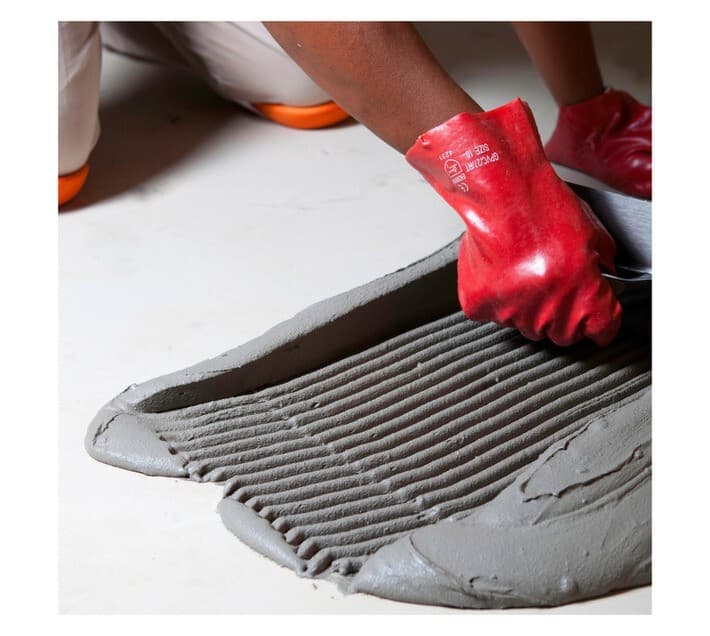
Cement-based tile adhesive is a mixture of cement as the main gelling material, combine together with thickener, water-retaining agent and other organic admixtures, and mineral fine aggregates. After mixing with water or other solvents, it can greatly improve the bonding strength between the finishing material and the substrate. Compared with ordinary cement mortar, it has good anti-slip properties, excellent water resistance, heat resistance and freeze-thaw cycle resistance. It is mainly used for pasting ceramic tiles, facing tiles, floor tiles and other decorative materials. It is widely used in the finishing and decoration of internal and external walls, floors, bathrooms, kitchens and other buildings. It is currently the most widely used ceramic tile adhesive material.
The influence of the amount of RDP on the performance of tile adhesives
The important organic additive in cement-based tile adhesives is RDP. The addition of RDP has a very obvious effect on the improvement of the performance of cement-based tile adhesives. It has a significant enhancement effect on the bonding strength, water resistance and aging resistance of the adhesive. At present, there are many types of RDP on the market, such as acrylic RDP, styrene-acrylic powder, vinyl acetate-ethylene copolymer, etc. Generally speaking, the RDP used in tile adhesives on the market is mostly vinyl acetate-ethylene copolymer.
With the increase of the amount of RDP, the strength of cement-based tile adhesive after water immersion and heat aging both show an increasing trend. However, the increasing trend of strength after heat aging is more obvious. This is because when the amount of other raw materials remains unchanged, the amount of RDP increases. And the flexibility of tile adhesive increases. The damage caused by the change of stress under high temperature to the bonding performance of tile adhesive is reduced, which is manifested as an improvement in bonding performance. It is directly reflected in the increase of bonding tensile strength after heat aging. After the cement-based tile adhesive is treated with water immersion, the entry of water destroys the van der Waals force at the interface between tile adhesive and tile. Under the same raw materials and dosage conditions, the increase in the amount of RDP improves the density of the tile adhesive. The phenomenon of water entering the interior of the tile adhesive and destroying the van der Waals force is correspondingly slowed down, thereby improving the bonding tensile properties of the tile adhesive after immersion in water. Combining these two reasons, the increase in the amount of RDP increases the tensile adhesive strength of the tile adhesive after immersion in water and the tensile adhesive strength after heat aging. However, the increase in tensile strength after heat aging is more obvious. It may be that the heat aging resistance of the tile adhesive is more closely related to the flexibility of the tile adhesive, and the RDP is directly related to the flexibility of the tile adhesive.
Effect Of Cellulose Ether Dosage On Tile Adhesive Performance
Cellulose ether has a very important influence on cement-based tile adhesives. In addition to improving the construction performance of cement-based tile adhesives, it also has a very important influence on the tensile bonding properties of tile adhesives. With the increase in the amount of cellulose ether, the tensile bonding strength of the tile adhesive after immersion in water first increases and then decreases, while the tensile bonding strength after heat aging increases. The reason is that with the increase in the amount of cellulose ether, the water retention effect of the tile adhesive is improved. The gelling component in the tile adhesive is hydrated more completely. As a result, the tensile bonding strength between the tile adhesive and the tile increases. However, cellulose ether has a certain effect. When the amount of cellulose ether increases to a certain extent, a bubble baseline is introduced. The density of tile adhesive decreases. The rigidity decreases, resulting in a decrease in the Manhattan adhesive strength of the tile adhesive after immersion in water. In addition, the amount of cellulose ether increases. The rigidity of tile adhesive decreases and its flexibility increases. The ability of cement-based tile adhesives to cope with stress changes at high temperatures is improved, as evidenced by the increase in tensile bond strength of cement-based tile adhesives after thermal aging. With the increase in the amount of cellulose ether, the tensile adhesive strength of the cement-based tile adhesive after thermal aging increases. The tensile strength after immersion in water shows a trend of first increasing and then decreasing.
Effect of cement dosage on tile adhesive performance
The raw material that plays the main role of gelling in cement-based tile adhesives is cement. The bonding force between cementitious materials and tiles is mainly the mechanical anchoring force between cement and the tile surface. As the amount of cement increases, the tensile bonding strength of tile adhesives tends to increase. This is because the amount of cement increases while the amount of glue powder remains unchanged. The water-cement ratio decreases. The rigidity of the cement-based tile adhesive paste increases. Under the same mass, the higher the amount of cement, the more “effective” cementing components increase, and the encapsulation of the cementitious materials and the test sand is enhanced. The bonding strength between the material and the tile is improved. As the amount of cement increases, the water immersion strength of the cement-based adhesive also increases. When the amount reaches a certain level, the trend of cement increasing the strength after immersion in water slows down. In addition, tile adhesives are mainly bonded by van der Waals force and mechanical anchoring. After immersion in water, the van der Waals force is destroyed and only the mechanical anchoring force of cement can be relied on. This anchoring force increases with the increase of cement dosage. When the amount of cement reaches a certain level, the strength will remain basically unchanged. When the amount of cement is greater than 35%, the heat aging resistance of tile adhesives is above 0.5MPa, which meets the standard requirements.
